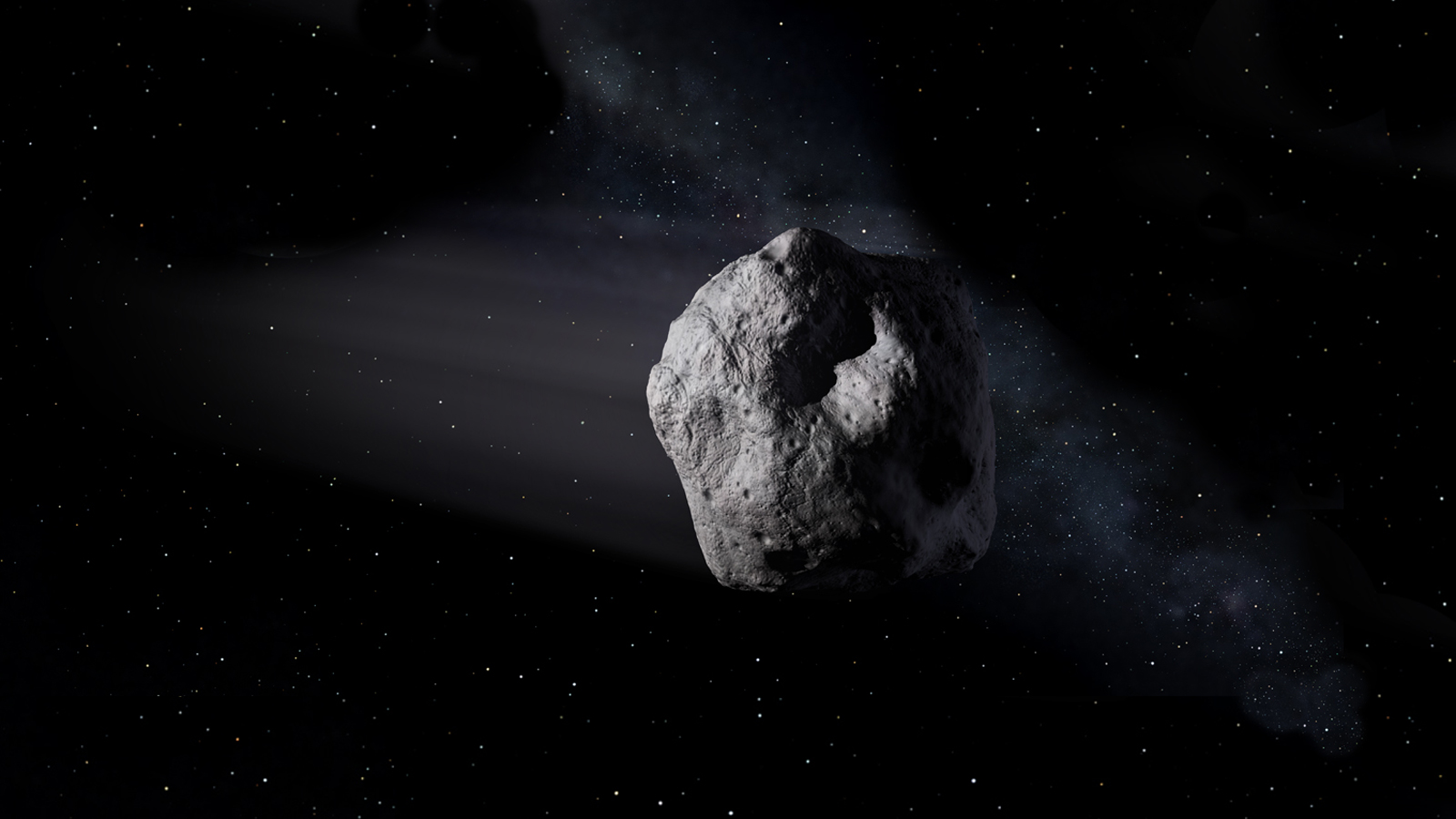
Artist's concept of a near-Earth object. Image: Courtesy NASA/JPL-Caltech
- NEO Close Approaches (more lists)
On January 12, 2026, at 10:26 UTC, the well-observed near-Earth asteroid 242708 (2005 UK1) will make, non-hazardous close approach of Earth, safely missing the planet by a wide margin.
At closest approach, the asteroid will pass at a nominal distance of 0.08259 AU (astronomical units, where 1 AU is the average distance from Earth to the Sun), equivalent to approximately 12.36 million kilometers, or about 1,939 Earth radii (one Earth radius is the distance from Earth's center to its surface), which is roughly 32 times the distance to the Moon from Earth’s center. Although this qualifies as a close approach in astronomical terms, it is far outside any impact or atmospheric-interaction range.
Object characteristics and orbit
242708 (2005 UK1) is classified as an Apollo-type near-Earth asteroid and is also listed as a Potentially Hazardous Asteroid (PHA) due to its size and Earth-crossing orbit—not because of any present danger. Its orbit is very well constrained, with a condition code of 0 and more than 1,100 optical and radar observations spanning over 20 years.
Key orbital and physical properties include:
- Absolute magnitude (H): ~18.1
- Estimated diameter: ~700 meters
- Orbit period: ~3.96 years
- Inclination: ~0.8° (very close to the plane of the solar system)
- Earth MOID: ~0.011 AU (~258 Earth radius)
The asteroid’s relative velocity at encounter is ~14.4 km/s, typical for Apollo-class objects making distant flybys of Earth.
Why this approach is notable—but not dangerous
Although 242708 (2005 UK1) is a large asteroid by near-Earth standards, the 2026 encounter poses no impact risk. The object was previously listed in NASA/JPL’s Sentry risk system, but all potential impact solutions were ruled out as early as 2005, and it has remained firmly off the risk list ever since.
The 2026 flyby is notable primarily because:
- The asteroid is relatively large (~700 m)
- The encounter distance is well within the range tracked by public close-approach tables
- The orbit is exceptionally well determined, making predictions reliable
This combination makes 242708 (2005 UK1) a reassuring, textbook example of how long-term tracking removes uncertainty and puts to rest any false impact concerns. The 2026 event clearly demonstrates effective monitoring and public safety.
Context among January 2026 close approaches
Within the ±7-day window surrounding January 12, 2026, multiple smaller near-Earth objects will pass closer to Earth than 242708 (2005 UK1). Several will come within a few lunar distances, whereas 2005 UK1 remains far beyond the Moon’s orbit, underscoring that distance—not size alone—determines risk.
Basketball-scale distance perspective
To make the distance easier to visualize, imagine Earth scaled to a basketball (about 9.5 inches or 24 cm in diameter). On that scale, the Moon would orbit at about 25 feet (7.6 m) away.
- Asteroid 242708 (2005 UK1), at its closest, would pass at a scaled distance of over 800 feet (≈ 245 meters) from the basketball-Earth—far past any zone of concern.
In other words, on this scale, the asteroid would not just miss the basketball—it would pass well beyond the length of two football fields, with the Moon comfortably in between. This comparison highlights just how vast empty space is, even during events labeled as “close approaches” in astronomical terms.
Bottom line
242708 (2005 UK1) will safely pass Earth on January 12, 2026, at a distance more than 30 times farther than the Moon, with a zero probability of impact. Its well-documented orbit and long observation history offer clear confirmation that this event poses no threat and exemplify the success of modern planetary-defense monitoring in ensuring public safety.
See this link for NEO Close Approaches — for 242708 (2005 UK1)