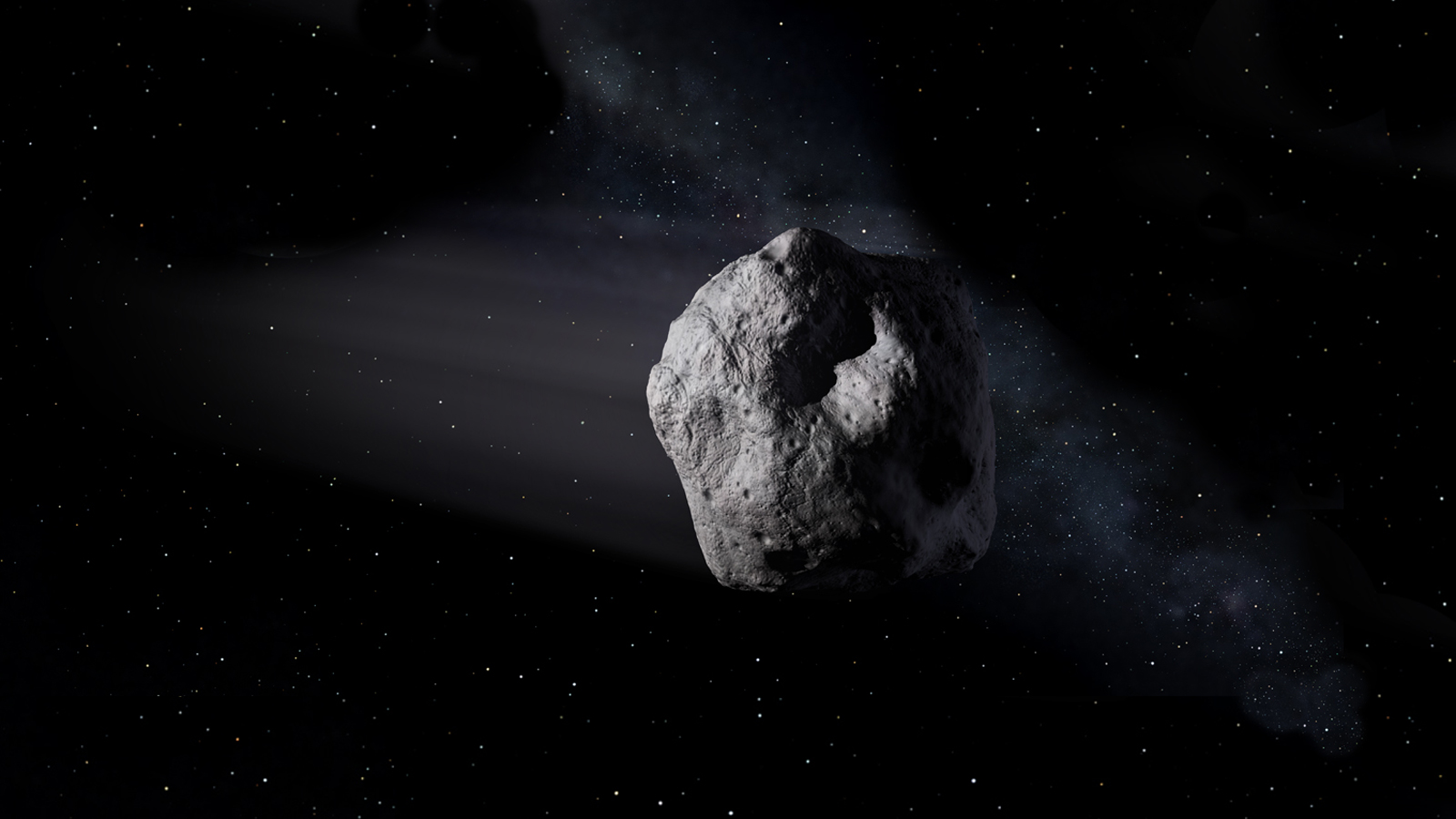
Artist's concept of a near-Earth object. Image: Courtesy NASA/JPL-Caltech
The James Webb Space Telescope observing schedule for the upcoming week has been released. Two planned observations of asteroid 2024 YR4 are scheduled for February 18, 2026, at 07:30 UTC. This observation is identified as Visit
ID 9441:1:1.
| Identification & Risk Status | |
|---|---|
| Object | (2024 YR4) |
| Orbit Type | Apollo (Near-Earth Object) |
| Approximate Diameter | ~54–60 meters |
| On NASA Sentry Risk Table | Yes |
| Torino Scale (current maximum) | 0 (was 3 in Jan 2025) |
| Palermo Scale (maximum) | -4.21 |
| Palermo Scale (cumulative) | -4.21 |
| On NEODyS/CLOMON2 Risk Page | Yes |
| Torino Scale (NEODyS) | 0 |
| Palermo Scale (NEODyS solutions) | -5.94 / -4.40 |
| IAWN Final Assessment | No significant impact potential for the next century (Feb 24, 2025) |
| Goldstone Radar Schedule | Planned Dec 2032 (Closest Approach ~0.0018 au) |
| Discovery & Observations | |
| Discovery Date | 27 December 2024 |
| Discovery Site | ATLAS Chile, Rio Hurtado |
| Earliest Observation (Precovery) | 25 December 2024 |
| Last Published Observation | 11 May 2025 |
| Optical Observations (published) | 504 |
| Oppositions | 1 |
| Observation Arc | ~138 days |
| Observatories Reporting | ~60+ |
| Orbital Elements (JPL SBDB Solution) | |
| Epoch | JD 2461000.5 (2025-Nov-21.0 TDB) |
| Uncertainty Parameter (MPC) | 4 |
| Semimajor Axis (a) | 2.51584 AU |
| Eccentricity (e) | 0.66147 |
| Inclination (i) | 3.408° |
| Longitude of Ascending Node (Ω) | 271.364° |
| Argument of Perihelion (ω) | 134.366° |
| Perihelion Distance (q) | 0.85168 AU |
| Aphelion Distance (Q) | 4.180 AU |
| Orbital Period (sidereal) | 1457.55 days (3.99 years) |
| Mean Motion | 0.24699°/day |
| Mean Anomaly | 89.807° |
| Earth MOID | 0.00280 AU |
| Jupiter MOID | 1.271 AU |
| Physical Characteristics | |
| Absolute Magnitude (H) | 23.9 |
| Geometric Albedo (estimated) | ~0.15–0.18 (model-dependent) |
| Spectral Type | S-type (most likely); R- or Sa-type also consistent |
| Rotation Period | 19.4634 ± 0.0003 minutes |
Data compiled from NASA JPL SBDB, CNEOS Sentry, NEODyS-2, ESA NEO Coordination Centre, and the IAU Minor Planet Center.
Links
- MPC Database Search: 2024 YR4
- NASA/JPL Small-Body Database Lookup (2024 YR4)
- NEOfixer (2024 YR4)- The University of Arizona.
- Asteroid 2024 YR4 reaches level 3 on the Torino Scale (Jan 31, 2025 — now outdated)
- Dark Skies Bring New Observations of Asteroid 2024 YR4, Lower Impact Probability (Feb 19, 2025)
- Latest Calculations Conclude Asteroid 2024 YR4 Now Poses No Significant Threat to Earth in 2032 and Beyond (Feb 24, 2025)
- NASA Update on the Size Estimate and Lunar Impact Probability of Asteroid 2024 YR4 (Apr 2, 2025)
- Asteroid 2024 YR4 no longer poses significant impact risk (Apr 2, 2025)
- 2024 YR4 Facts
- Notification of Potential Impactor: Asteroid 2024 YR4 (PDF — Jan 29, 2025 — now outdated)
- Final Notification: 2024 YR4 (PDF — Feb 24, 2025 — No Significant Potential for Future Impact with Earth)
- International Asteroid Warning Network: 2024 YR4
- Physical Characterization of 2024 YR4 (PDF)
- Sentry: Earth Impact Monitoring (2024 YR4)
- NEODyS-2 Dynamic Site (2024 YR4)
- ESA Near-Earth Objects Coordination Centre (2024 YR4)
- Asteroid 2024 YR4 (NIRCam and Webb images)
- Lessons Learned from Near-Earth Asteroid 2024 YR4 and the International Coordination that Retired the 2032 Earth Impact Risk (PDF — May 2025)
- Will asteroid 2024 YR4 impact the Moon?
- Goldstone Schedule - Asteroid Radar Research
- How to Create an Asteroid Impact Risk Corridor Using Find_Orb