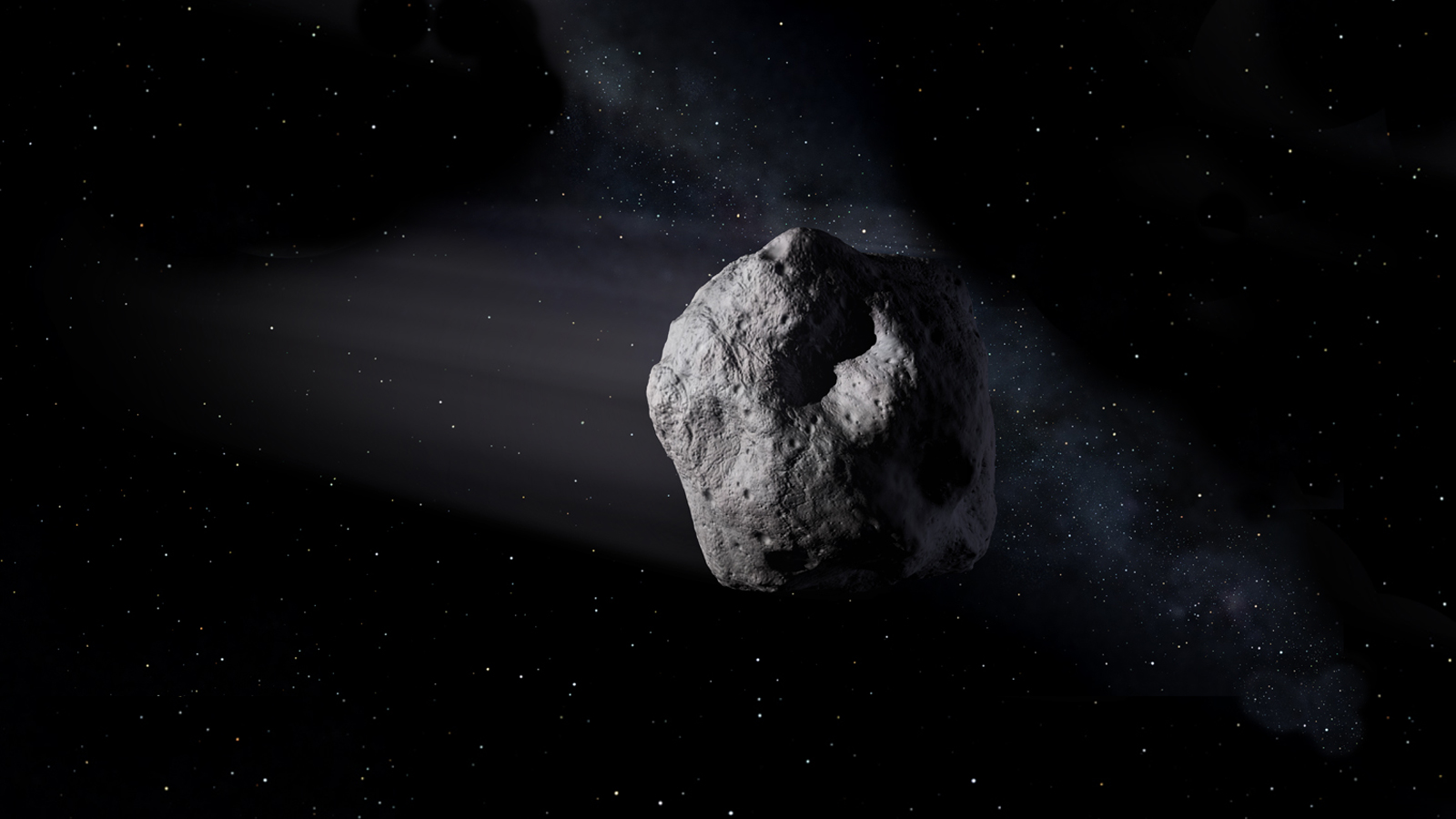
Artist's concept of a near-Earth object. Image: Courtesy NASA/JPL-Caltech
- 100 Closest Known NEO Approaches from 1900 to 2200
- NEO Close Approaches (more lists)
NEO close approaches are sorted by date and time.
Fullname: (2025 QV9) | H: 25.07| Diameter (0.25 albedo, meters): 25.7413 | Diameter (0.15 albedo, meters): 33.2318 | Diameter (0.05 albedo, meters): 57.5592
| Calendar Date | Nominal Distance (Earth Radii) | Nominal Distance (LD) | Nominal Distance (AU) | Nominal Distance (km) | Relative Velocity (km/s) | Infinity Velocity (km/s) | Time ~ |
Note: Distances are scaled as If the Earth were the Size of a Basketball. | ||
|---|---|---|---|---|---|---|---|---|---|---|
| Scale Model Distance (Inches) | Scale Model Distance (Feet) | Scale Model Distance (Meters) | ||||||||
| Earth radius | 1 | 0.0166 | 0.00004 | 6378 | — | — | — | 4.73 | 0.39 | 0.12 |
| 1914-11-15 22:08 | 4051.30 | 67.146 | 0.17253 | 25810800 | 9.03 | 9.03 | 9 | 19177.61 | 1598.13 | 487.11 |
| 1946-08-24 04:46 | 2340.82 | 38.796 | 0.09969 | 14913400 | 7.16 | 7.15 | 1 | 11078.74 | 923.23 | 281.40 |
| 1949-10-30 23:40 | 1404.24 | 23.274 | 0.05980 | 8946420 | 5.19 | 5.18 | 5 | 6644.15 | 553.68 | 168.76 |
| 1981-09-05 05:58 | 673.75 | 11.167 | 0.02869 | 4292470 | 5.01 | 4.99 | 3 | 3185.38 | 265.45 | 80.91 |
| 1984-11-05 00:52 | 1809.10 | 29.984 | 0.07705 | 11525800 | 5.81 | 5.81 | 4 | 8561.10 | 713.43 | 217.45 |
| 2025-09-10 13:29 | 315.33 | 5.226 | 0.01343 | 2008970 | 4.61 | 4.57 | 0 | 1488.31 | 124.03 | 37.80 |
| 2028-09-14 15:06 | 98.92 | 1.639 | 0.00421 | 630199 | 4.43 | 4.29 | 0 | 463.62 | 38.64 | 11.78 |
| 2065-08-21 15:40 | 3351.62 | 55.549 | 0.14274 | 21353200 | 8.52 | 8.52 | 3 | 15864.72 | 1322.06 | 402.96 |
Asteroids follow predictable orbits governed by well–understood celestial mechanics. The “known” orbit of an asteroid is determined by calculating the ellipse around the Sun that “best” places the object in the sky where it was observed. Astronomers adjust the orbital elements until the asteroid’s postdicted positions “align” with its observed positions. There is no such thing as a perfectly “known” orbit. As additional observations are collected, the orbit is refined, increasing confidence in both postdicting the object’s past positions and predicting its future positions. Postdiction allows precovery searches, in which older astronomical images are examined to detect the object at dates prior to its official discovery.
Near–Earth objects can sometimes pass relatively close to Earth as they orbit the Sun. However, “close” in astronomical terms still often means millions, or even tens of millions, of kilometers. To put these encounters into proper context, our NEO close approach tables list recorded, postdicted, or predicted close approaches of known NEOs. Distances are shown in multiple units: astronomical units (AU), lunar distances (LD), kilometers, and Earth radii to help illustrate the true scale of these flybys. Inclusion in this list does not necessarily imply an impact threat; it reflects orbital geometry and well–understood celestial mechanics.
The raw data for this web page is from the The JPL Center for NEO Studies (CNEOS) and was pulled from the API webpage coding was done with the aid of Chatgpt under the guidance of webmaster.